



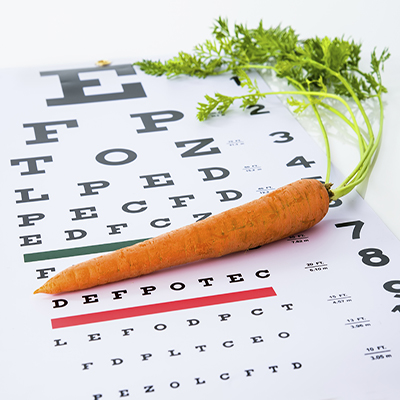
 Some of us may still remember the slogan in the war ‘Carrots keep you healthy and help you see in the blackout.’ Government propaganda suggested that beta-carotene (or vitamin A) which helps night vision was responsible for the RAFs increasing success in shooting bombers. People eagerly tucked into carrots – this not only made good use of the surplus vegetable but also helped mask the real reason for the RAFs success — the improvement in radar technology. Seventy years later, vision and carrots are being investigated again, this time though in relation to the intake of coloured vegetables and age-related macular degeneration (AMD).
Can fruit and veg help reduce AMD – the most common cause of age-related loss of vision?
We are increasingly aware of the potential health benefits of fruit and veg consumption, including reduced risk of heart disease, stroke, type 2 diabetes and obesity. But is there any evidence that they are associated with lower risk of developing AMD? This is a progressive condition and is the most common cause of age-related loss of vision, affecting the macula in the centre of the retina at the back of the eye.
A study from Harvard School of Public Health published this month in JAMA Ophthalmology reported data from around 102 000 US men and women, who were aged 50 or older and who did not have a diagnosis of cardiovascular disease, diabetes cancer or AMD at the start of the study. In a 25 year follow-up, 1361 cases of intermediate and 1118 advanced cases of AMD were confirmed.
What about carrots and risk of AMD?
The researchers were interested in the associations between the intake of carotenoids, naturally occurring chemicals which give fruit and vegetables their colour, and AMD. From their data analysis, the researchers reported that subjects who had the highest consumption levels of carotenoids, in particular lutein and zeaxanthin, had a 40% lower risk of a diagnosis of advanced AMD compared to low consumers. High consumption of these carotenoids meant for example 5 or more cup servings of spinach, or 5 or more half-cup servings of carrots a week. Other forms of carotenoids were also found to be beneficial. Greater levels of consumption of beta cryptoxanthin, alpha carotene, and beta carotene were all associated with a 25 -35% lower risk of advanced AMD compared to those who ate very little of these carotenoids. However, none of the carotenoids in this study were found to be associated with lower risk of intermediate AMD.
The research had its limitations; the researchers predicted plasma carotenoid levels from fruit and vegetable intake using food frequency questionnaires (known to be unreliable), rather than taking blood measures, which could have validated the reported carotenoid intakes. Importantly, this type of study can’t prove a direct cause-and-effect between eye health and eating more carrots and other vegetables.
Carotenoids are typically present in produce with red, orange, or dark green colouring. Lutein and zeaxanthin can be found in kale, red/orange peppers, spinach, squash and corn.
Eat your carrots (and your greens and your oranges)
So carrots and other brightly coloured fruit and veg really may benefit our eyes, but in any case a wide variety of fruits and vegetables rich in carotenoids is compatible with current dietary guidelines and supports healthy eating messages like the 5-a-day campaign.