



The Health and Care (Staffing) (Scotland) Act 2019
In 2024 a new Act came into force called The Health and Care (Staffing) (Scotland) Act 2019.
The work on this new legislation started in 2019, then as the pandemic ensued there were obviously other priorities.
This new legislation was developed by the regulator, involving professionals from various disciplines and providers whilst using guidance such as the Health and Social Care Standards and the various inspection frameworks developed by the Care Inspectorate.
Let us have a look at the Act.
Part 1 – Health and Care (Staffing) (Scotland) Act 2019
To provide safe and high-quality services to ensure the best care outcomes for Service Users, the provider must use the guiding principles of the (The Health and Care (Staffing) (Scotland) Act 2019) Act below.
- Improving standards and outcomes for service users
- Taking account of the needs, abilities, characteristics, and circumstances of different service users
- Respecting the dignity and rights of service users
- Taking account of the views of staff and service users
- Ensuring the wellbeing of staff ~ Being open with staff and service users about decisions on staffing
- Allocating staff efficiently and effectively
- Promoting multi-disciplinary services as appropriate
These are similar principles that were in Regulation 16 of the Public Services Reform Act., which will be revoked on 1/4/24 when the Health and Care (Staffing) (Scotland) Act 2019) Act becomes law.
The main difference is the focus on staff wellbeing.
Staff Wellbeing
The benefits of focusing on staff wellbeing are:
- Increased productivity
- Improved performance
- Sustained workforce
- Better attendance
- Improved satisfaction
- Increased morale
Healthy, engaged, well supported staff are better able to provide safe and high-quality services. Below are some free resources which you can use with staff.
Staff wellbeing resources
https://www.seemescotland.org/search-results?search=staff+wellbeing+resources
Part 3 – Health and Care (Staffing) (Scotland) Act 2019 states the factors, which help determine what staffing levels are required.
- Have regard to the nature and size of the care service
- Aims and objectives
- Number and needs of the service users experiencing care
- Suitably qualified and competent individuals are working in the care service for the health, wellbeing and safety of the service users experiencing care
- Staff receive appropriate training for the work they are to perform Suitable assistance, including time off work, for the purpose of obtaining further qualifications appropriate to their work
The focus must be on ensuring services have the right people, in the right place, with the right skills at the right time working to ensure service users experience the best health and care outcomes.
How will staffing levels be assessed?
Staffing levels will be determined by:
- an assessment of the needs of the service users
- the skills, competencies, and number of all staff within the service
- the environment will affect the staffing assessment as some premises may require more staff due to the layout and observational challenges
There is no national staffing tool advised at this time. However, the Care Inspectorate has consulted with stakeholders and are now undertaking a review of staffing tools for use in a social care setting.
Currently you as the provider should use a tool of your choice. There are links to various dependency staffing tools at the end of this document.
The staffing calculation must be reviewed, using staff, service users, and relative/carer feedback. You, as the provider can therefore demonstrate the full commitment that you have placed on ensuring that staffing levels are set to achieve the best outcomes for Service Users.
It is important that you have evidence of seeking the views of service users, staff, relatives and visiting professionals. Here at QCS we have included a question in the relevant satisfaction surveys. Of course, asking the question is only the start of the evidence, most importantly is recording how it was considered and any change that was implemented as a result of others’ opinions.
Promoting Multidisciplinary Involvement
When liaising with our multidisciplinary colleagues, you should take the opportunity to gain their views on staffing. They may have opinions through observations and communication with staff on the strengths and weaknesses. This can then be used when looking at training and development of staff and staff allocation. Another method can be as mentioned previously include this in the satisfaction survey for visiting professionals.
This involved creating a culture of transparency, continuous improvement, and open communication. (Care Inspectorate, 2024 – Health and Care (Staffing) (Scotland) Act 2019 a short guide).
Environmental factors
These must also be considered; the layout of the premises can have an impact on the staffing numbers as some environments may present challenges on observation.
Allocation of staff must also be considered not only to ensure a safe and competent skill mix but to reflect Service Users’ choice and preferences on who will support them.
Staff Training
The legislation clearly states that it is the responsibility of the provider to ensure that people working in the service receive appropriate training for the work they are about to perform, this includes time off from work for the purpose of obtaining further qualifications appropriate for their work.
There is an Open Badge training resource on Scottish Social Service Council (SSSC) website on Safer Staffing which will support staff understand the new Act.
Open Badges – Safe and effective staffing
https://www.badges.sssc.uk.com/badges/safe-and-effectivestaffing/
Guidance used to develop the Act
The Health and Social Care Standards will help to assess what the Service User can expect in terms of care delivery, which of course takes time and skill to deliver high quality care with excellent outcomes.
The Health and Social Care Standards 3.14 to 3.19 are of relevance to the contents of the Act.
Health and Social Care Standards
Health and Social Care Standards: my support, my life – gov.scot (www.gov.scot)
Quality Framework
A quality framework for care homes for adults and older people
The Quality Framework developed by the Care Inspectorate clearly identify the standards and expectations required to ensure the desired outcomes are achieved for each Service User, aiming for excellent care delivery.
These documents will help you assess not only the number of staff, but the skills required to deliver the quality indicators.
Staffing method framework wheel
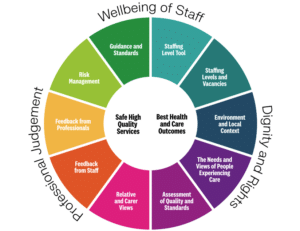
The Care Inspectorate developed this wheel which covers all aspects to be considered and a useful tool to use for staff training/development. Throughout the entire process when looking at various cogs on the wheel, it is important to say professional judgement must be used when arriving at your decision and recorded. It is important to record why you arrived at your decision.
Looking at data such as accidents and incidents, complaints, minutes from service user, staff, and relative meetings. Observation of staff on how they plan the daily routine, are they considering the wishes and preferences of the people they support.
There you have it, the legislation, EXPLAINED
Useful Resources
Safe Staffing Programme – https://www.careinspectorate.scot/quality-improvement/quality-improvement-programmes/safe-staffing-programme
Care Inspectorate Scotland: Guidance for providers on the assessment of staffing levels in premises-based care services Solutions – https://lswcaresolutions.co.uk/care-inspectorate-scotland-guidance-for-providers-on-the-assessment-of-staffing-levels-in-premises-based-care-services/
Staffing Method Tools Indicator of Relative Need (IORN) – https://www.gov.scot/publications/single-shared-assessment-indicator-relative-need-operational-guidance-users-handbook/pages/4/
Barthel Index – https://www.cgakit.com/f-1-barthelindex
RCN – Guidance on safe nurse staff levels in the UK (Appendix 2 contains a number of staffing tool reviews) – https://www.rcn.org.uk/-/media/Royal-College-Of-Nursing/Documents/Publications/Obselete/PUB-003860.pdf
Download Pocket Booklet