

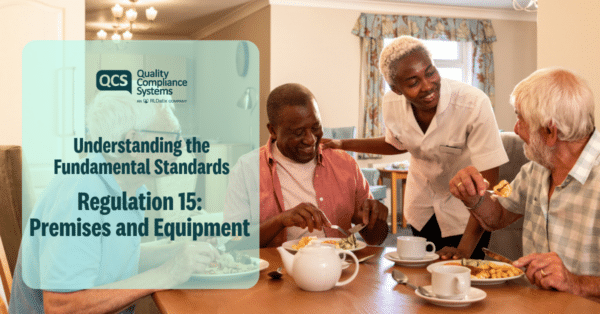
This is the next article in our series examining the CQC fundamental standards and their practical implementation across social care services. This time, we look at Regulation 15 – Premises and Equipment.
At first sight, Regulation 15 may seem straightforward: premises and equipment must be clean, secure, suitable, properly used and maintained. However, as with most of the regulations we have looked at in this series, it is much broader than purely evidencing maintenance schedules and cleaning records.
The important point is that the environment is part of the care and ultimately affects the quality of care provided. A poorly maintained hoist, an unsuitable bathroom or inadequate infection control arrangements can all affect the quality and safety of someone’s care, and Regulation 15 can be used to enforce shortfalls.
What does Regulation 15 require?
Regulation 15 requires premises and equipment to be clean, secure, suitable, properly used, properly maintained and appropriately located, with appropriate standards of hygiene maintained.
These requirements need to be considered in the context of the people using the service. Something may be in good physical condition but still be unsuitable for the person using it. Equipment may be available but poorly located; it may also be properly maintained but being used by someone who has not been trained to use it.
For providers, the question is therefore not simply whether equipment has been serviced, or a cleaning checklist completed. It is whether the premises and equipment are effective and they enable and promote good quality care delivery.
Putting Regulation 15 into practice
For residential services, this means keeping a close eye on the whole environment — bedrooms, bathrooms, communal areas, kitchens, outdoor spaces and equipment used to support people’s care.
For domiciliary care, the situation can be more complex because the provider is working within someone else’s home and may not be fully responsible or have control over the environment. However, the provider still needs to recognise and manage the risk. This could mean working with the person, their family or other professionals and to manage issues by developing appropriate risk assessments.
Regulation 15 also needs to be viewed alongside other fundamental standards. For example, a poorly maintained hoist being used by an untrained care worker could raise concerns under Regulation 15 in relation to the equipment, Regulation 12 because of the risk to the person and Regulation 18 because of staff training and competence. If the provider’s auditing and assurance systems had failed to identify the problem, Regulation 17 could also be relevant.
This is why a problem with premises or equipment should not automatically be treated as an isolated issue. It may provide CQC with evidence of wider weaknesses in how a service is managed.
What evidence will CQC look for?
Evidence should demonstrate that providers are actively monitoring their premises and equipment and acting when problems arise.
This might include risk assessments, health and safety checks, cleaning and infection control audits, servicing and maintenance records, competency assessments and records showing that identified issues have been addressed.
But this does not mean creating endless paperwork. Existing management activity can provide valuable evidence. This may include managers’ walk-arounds, observations, discussions with staff and people using the service, and issues raised through team meetings which can all demonstrate effective oversight of this regulation. However, any issues do need to be backed up with an action plan – to document what has been done and to show improvement.
CQC can test the evidence against what it sees and hears. A completed cleaning schedule will not compensate for an environment that is visibly unclean, and an equipment servicing record does not demonstrate competence if staff cannot use the equipment safely.
The strongest position is where the records support what CQC sees in practice.
Why Regulation 15 matters
It is easy for problems with premises and equipment to become normalised. A small defect, an awkward layout or worn equipment can become something staff simply work around and over time accept. That is why effective and objective oversight matters, and why an understanding of this regulation is important.
It is important to say that CQC cannot prosecute a breach of Regulation 15 itself, but it can take regulatory action where it considers this appropriate. Evidence may also contribute to breaches of other regulations that can carry prosecution.
Ultimately, Regulation 15 asks providers to look at their environment through the eyes of the people receiving care. Is it clean? Is it suitable? Is equipment safe and usable? Does the environment support safe and dignified care?
Those are more meaningful questions than whether a checklist has been completed — and they are the questions good providers should be asking before CQC does.
Look out for the next instalment in our fundamental standards series covering Regulation 13 – Safeguarding Service Users from Abuse and Improper Treatment.
Download the blog